
Bongani Kunene
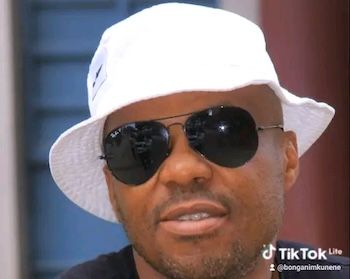
\Thumbnail: Bongani Kunene has spent most of his life fighting against the oppressive Swaziland monarchy. His efforts have resulted in threats, slander, and a shooting that required his leg to be amputated. After fleeing to South Africa, he continues organizing, protesting, and challenging authorities, as well as promoting health and education.
Profile: Bongani Kunene has a long history of activism, tracing from his country of origin, Swaziland. It started when, as a young boy, Kunene saw how the police denied his grandmother, a traditional beer brewer, the right to brew beer. “I grew up in a family where my grandmother was surviving by selling traditional beer,” says Kunene. “I was outraged each time when police came to raid my grandmother’s house. Police brutality on my grandmother, almost on a daily basis, ignited the spirit of activism, forcing me to be an activist.”
This marked the beginning of a long activist journey. At 14, Kunene participated in clean-up campaigns in his community. He later joined a broad democratic movement, the Swaziland Youth Congress (Swayoco), that sought to challenge the tyranny of Swaziland’s king. Swayoco demanded free and compulsory education for all.
“I organised most protests against the regime in Mombane. I joined the struggle for system and regime change,” recalls Kunene. “Through my activism I was always part of anything that was positive for the community or that will benefit the community.”
In his fight to advance the health of all in Swaziland’s fragile health system, Kunene also joined the People’s United Democratic Movement. He helped to form the Swaziland National Network of People Living with HIV and AIDS, the Msundusa Youth Development Association, the Mbambane Youth Development Association, and finally Swaziland Youth United against HIV/AIDS, organisations that fought discrimination and helped to promote access to treatment for people living with HIV/AIDS.
Later, in an act of defiance, Kunene fearlessly reconnected water taps after the city council had disconnected them: “I am the first person to connect water in my community due to poor service delivery by authorities. I mobilised the whole community to join this campaign, and this spread to other communities. . . . I was also forced behind the formation of a malnutrition soup kitchen for elders living with chronic diseases with the objective of improving community and encouraging food sovereignty platform.” In 2022 Kunene and colleagues formed the Swaziland victims of Torture and Massacre, an organisation that advocates for the rights of victims of political violence in his home country.
All this has come with severe risks. As he acknowledges, “In Swaziland, to join the struggle as an activist is viewed as taboo and being against the king.” In 2021, Kunene was shot and injured by the police in a protest that claimed the lives of over 120 people, with hundreds of others wounded. Kunene’s right leg had to be amputated. After that, Kunene wanted accountability: “After discharge from hospital, I mobilised other comrades to form Swaziland Massacred Victims and Survivors Association, where we demanded accountability from King Moswati himself; this angered him more and they decided to criminalise us and tried to arrest us and some of us had to run into exile. On the 16th of October 2022 I got the tip-off that I was going to be arrested, and I had to run into exile.”
In 2023, Kunene, now in South Africa, helped to form the Thulani Maseko Foundation and became its first Regional Facilitator. Thulani Maseko Foundation was formed to remember the assassination of human rights lawyer Thulani Maseko and all victims of persecution by the monarch in Swaziland.
Even in exile, Kunene continues to address the crises in Swaziland: “We do mobilize for solidarity support from social movements, trade unions, activists, and like-minded institutes to expose the ongoing human rights abuses in Swaziland. We use public demonstrations and petitions at relevant Government departments in South Africa seeking diplomatic intervention,” said Kunene. “Meanwhile, I am involved in capacity building using advocacy within solidarity networks to educate people about patriarchy, monarchy, and hegemony in Eshwati, which is part of the system forcing people to flee to South Africa.”
In addition to all that, Kunene organises art events to inform and educate communities on the ongoing violations in his home country. Recently, Kunene and his colleagues organised a live performance of a new radio play entitled “The Struggle for Swazini”. The event’s statement: “The play is dedicated to those who lost their lives at the hands of the Royal police during the July 2021 uprising calling for democracy and free political activity, to the survivors of the repression that put down the mass mobilization, and to all those still engaged in the struggle to liberate Swaziland from the oppressive rule of an absolute monarchy.”
Kunene also works with Abahlali Base Freedom Park to advance the rights of the homeless and shack dwellers: “We fight for food, land, dignity, and social justice for all.”
In South Africa, Kunene is considered an enemy of the state intent on destabilising Swaziland, serious accusations he denies. In 2023, the state-owned media launched an onslaught on his character. But Kunene was not fazed: “Most of these newspapers and mushrooming online newspapers pursue a capitalist agenda which supports the monarch. I am not part of them. I come from the Black Power Community. . . . These attacks are meant to demobilise the mass democratic movement in Swaziland.”
Kunene is resilient, determined to free the world from capitalist oppression: “I will not quit activism until we achieve freedom for our people, not just Swaziland but for Africa and the world to be liberated from the barbaric system of capitalism. . . . We can be arrested, killed, and destroyed any time. We can face a high level of stigma in revolutionary space and infiltration of the enemy in the Mass Democratic Movement. But we shall soldier on.. . . It is war against colonialism. It is war against human rights violations. We fight for decolonised space in Swaziland. It's a war against hunger, hopelessness, a war against poor levels of education. We are in a war against the ruling of one man and his Royal Family. We want to say no to royal supremacy.”
Kunene summarizes his struggle with this: “We are calling on all displaced and oppressed people to unite. We need to have dialogue amongst ourselves to know each other’s challenges, hopes, and achievements, and find one common goal to fight our oppressors and uplift the oppressed.”