
Pumza Dabata
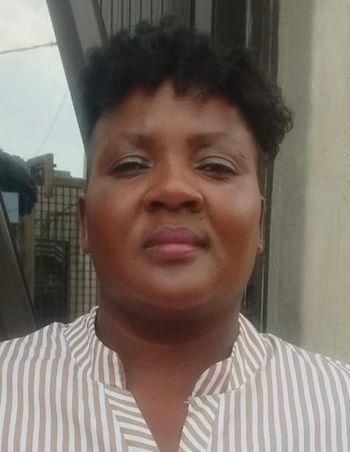
Thumbnail: For decades, Pumza Dabata has fought for land, decent housing, employment, and food sovereignty in Freedom Park, South Africa. She is the Chairperson of Abahlali Base Freedom Park, a network of shack dwellers fighting for decent housing, land, and employment. Dabata’s work is often full of challenges: She has been a target of hitmen several times and has also been unlawfully arrested by the police. But Dabata believes that activism is part of her identity; she vows to never stop fighting.
Profile: Pumza Dabata began fighting for the poor and disenfranchised when she was in her 20s: “I started my activism in the early 2000's at a time when Freedom Park was having problems with electricity,” she recalls. “First, I was inspired by the teachings of the Socialist Party of Azania. In order to bring people from different backgrounds, we then started an organisation called Abahlali Base Freedom Park, a civic movement. Our slogan was ‘Land, Decent Houses, and Jobs’.” Abahlali Base Freedom Park was involved in organising the homeless, the landless, and the poor to peacefully occupy vacant land for housing and community gardens.
“The first occupation was in 2007,” says Dabata. “We realised the land was owned by the Roman Catholic Church. The church came on board and later gave the land to the community. The process of acquiring this piece of land for housing was not easy; we were evicted by the police. But we kept on pushing until we acquired the land.”
Despite Dabata’s and her colleagues’ critical role in acquiring land that led to the construction of Freedom Park Extension 35, the government excluded them in the consultation process: “Although the land was later developed, we were not satisfied by the process. There was no engagement with the community by responsible authorities. The development excluded us as a movement.”
But Dabata and her colleagues persevered: “In 2013, we occupied a piece of land owned by the municipality; we were in and out of the place due to evictions.”
So they took the city of Johannesburg to court. They lost the case, but they gained valuable information about negotiating with the government.
After that, Dabata started organising women. In a community with high levels of food scarcity and starving populations among the elderly, she came up with the idea of a soup kitchen. And even that had risks; she was constantly “spooked” by not only the police but also other organisations that didn’t want Abahlali Base Freedom Park creating a soup kitchen. Nonetheless, the soup kitchen was successful, providing a safe space for the elderly. Today, it has about 160 customers.
The most recent initiative for Dabata was a community gardens initiative: “In our country everything is expensive. People cannot afford fresh vegetables. Then we came up with a one-household one-garden campaign. Today, 20 households take part.”
Of course, political threats are constant and real. They started when Dabata and Abahlali decided to take part in local elections.
“Some politicians and hired thugs came to our public meetings and disrupted the meeting,” remembers Dabata. “Some sent hitmen to come and disrupt us during public discussions. A day before elections, myself and other comrades were tipped off that a hitman was assigned to kill us. Then we went into hiding and came back after elections.”
And the threats continued: “When we were evicted on our last occupation, I got shot by the police on my left leg.”
Given all that, however, Dabata is determined: “I can't stop my activism. This thing is in me to fight for marginalised people; [it’s] what I believe. So I will never stop the struggle.”