
Sheffra Dzamara
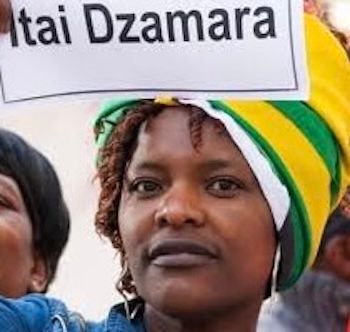
Thumbnail: Sheffra Dzamara has become a powerful voice for justice in Zimbabwe, carrying the weight of unanswered questions about her husband, Itai Dzamara’s disappearance since March 2015. Her story is one of grief, resilience, and unyielding advocacy, as she continues to demand accountability from authorities and keep her husband’s memory alive.
Profile: Sheffra Dzamara: A Woman’s Relentless Fight for Truth and Justice.
Eleven years after her husband, journalist and activist Itai Dzamara, was abducted in Harare, Sheffra Dzamara continues to press for answers from Zimbabwean authorities, turning private grief into a public campaign for justice.
Itai Dzamara, a prominent critic of then‑President Robert Mugabe, was taken by unidentified men on March 9, 2015, from a barber shop in Glen View, a suburb of Harare. Witnesses said he was handcuffed and forced into a vehicle. Despite court orders directing the state to investigate, his fate remains unknown.
For Sheffra, the disappearance was both a political and personal tragedy. Left to raise two children, Nokutenda(18) and Nenyasha (14), she has spoken of the pain of living with uncertainty. “Itai was a loving father who enjoyed cooking for us on Sundays. His absence is a wound that never heals”. The kids are now about 18 and 14 years old, having grown through adolescence in the shadow of their father’s disappearance. “I will not stop asking until I know the whereabouts of my husband. Itai was my husband and best friend. He was a great father to our two children. He was always there for us, making sure that we were happy. Itai was amazing,” she added.
Sheffra has spoken frequently about the psychological torture of being unable to tell her two children, Nokutenda and Nenyasha, whether their father is alive or dead.
She recently sent a letter to President Emmerson Mnangagwa requesting him to shed light on her husband’s whereabouts and to ascertain what happened to him.
“The president hasn’t responded to my petition,” said Sheffra.
International rights groups, including Amnesty International and Human Rights Watch, have repeatedly called on the Zimbabwean government to establish an independent inquiry into the case. The authorities have denied involvement and offered no credible explanation. The United Nations has also urged Zimbabwe to account for Dzamara’s whereabouts, citing obligations under international law to investigate enforced disappearances.
Sheffra has emerged as a central figure in keeping the case alive. Over the years, she has addressed public forums, given interviews to local and international media, and joined campaigns demanding accountability. Her persistence has made her a symbol of resilience in Zimbabwe’s human rights movement, where activists often face intimidation and harassment.
The Dzamara case has become emblematic of broader concerns about political freedoms in Zimbabwe. Itai, who founded the protest movement “Occupy Africa Unity Square,” had staged demonstrations calling for Mugabe’s resignation and greater democratic reforms. His disappearance sent a chilling message to activists, many of whom scaled back public protests in the years that followed.
For Sheffra, the struggle is deeply personal. She continues to balance advocacy with raising her children, who have grown up without their father. “I will not rest until I know what happened to my husband,” she says. Her words reflect both determination and the emotional toll of unresolved loss.
Analysts say the case highlights the challenges facing Zimbabwe’s justice system, where politically sensitive investigations often stall. Despite repeated court applications by Dzamara’s lawyers from the Zimbabwe Lawyers for Human Rights (ZLHR), no progress has been reported.
Sheffra’s campaign has drawn international attention, ensuring the case is not forgotten. Her testimony has been cited in reports to the African Commission on Human and Peoples’ Rights and the UN Human Rights Council. For many Zimbabweans, her voice represents the demand for truth in a country where accountability remains elusive.
As Zimbabwe grapples with economic hardship and political divisions, the Dzamara case continues to cast a shadow. For Sheffra, the fight is not only about her husband but about the principle that no family should endure the pain of disappearance without answers.